

listing page or single post
https://www.hellersearch.com/blog
Heller Blog


IT inflation has jumped from 7 percent to as high as 15 percent in the first five months of 2026, while most IT budgets are increasing by less than 4 percent. Howard Rubin, founder of The Technology Economists, explains how to measure the gap, manage it, and recommend actions to your board.
Inflation is one of the most closely watched metrics in the world. Governments, central banks, investors, and corporate leaders track it relentlessly to guide policy, pricing, and planning.
Yet remarkably few IT organizations measure or manage a parallel force that directly undermines their technology investments: IT inflation.
IT inflation—the rising cost of labor, software, hardware, cloud, and services—jumped from around 7% per year to as high as 15% between December 2025 and May 2026. The recent spike reflects vendor price increases driven by chip and storage shortages, along with rising SaaS and cloud costs. Most IT budgets are increasing by less than 4%, according to Gartner's IT Key Metrics Data 2026, which projects an average increase of 3.8% across approximately 2,500 organizations worldwide. CIOs are losing purchasing power every year, even when they get a budget increase—and most aren't accounting for it in their planning.
The answer isn't just to ask for more budget. It's time to start managing technology spending like an economy: measuring IT inflation, connecting investments to outcomes, and treating technology economics as a discipline, not an afterthought.
The problem is already showing up in unexpected ways. Uber reportedly blew through its entire 2026 AI coding budget by April, TechCrunch noted. Microsoft revoked licenses for developers' AI coding tools to control costs, according to NextWeb. The executive director of the nonprofit FinOps Foundation told TechCrunch that companies started calling in April, saying they were already three times over their annual token budget. Token costs, which are the consumption-based pricing that companies pay for AI systems, are just one piece—IT inflation is eroding purchasing power across the board.
Yet most organizations are planning as if it doesn't exist.
Our survey data from approximately 3,000 IT organizations show that barely more than half (53%) plan to increase spending in 2026, while almost an equal number (47%) plan to decrease or keep IT expenses flat. Even planned increases fall far short of keeping pace with rising costs.
Where's the AI Spending Explosion?
One might ask: if everyone is investing in AI, why aren't IT budgets exploding? The answer is that the spending surge is on the sellers' side, not the buyers' side. AI vendors are building out data centers and products at the most expensive time in recent memory—with construction costs, materials, tariff impacts, and energy shortages all driving up prices.
The numbers tell the story: worldwide technology spending by vendors at the start of 2026 was approximately $7 trillion—$5 trillion in supply-side IT spending and $2 trillion in AI data center buildouts, based on our analysis at Rubin Worldwide. That means nearly 30 cents of every dollar in global IT spending is now going to AI data center infrastructure—a category that barely existed a decade ago. The question is whether buyer demand can keep pace with this supply-side spending surge.
And on the buyer side, costs are spiraling in unexpected ways. Agentic AI workflows—where AI tools orchestrate multi-step tasks—can cost roughly 30 times as much per interaction as simple chatbot queries did in 2023. A workflow that cost $0.04 per interaction three years ago now runs about $1.20. That math catches up fast.
IT Inflation vs. Other Economic Indicators
At 6.9%, IT inflation at the start of 2026 was the highest among all key economic indicators: higher than forecasted growth in 2026 global GDP (3%), global inflation (3.2%), US GDP (1.9%), and US inflation (2.5%), according to data from Rubin Worldwide, World Economic Forum, and the US Department of Commerce.
This is a force to be reckoned with in IT budgeting. IT inflation increases the cost of running the business and constrains a firm's ability to invest in growth and transformation.
Consider a global financial services firm with three billion outstanding shares and earnings per share of $10. If the firm spends $3 billion on AI, that's $1 per share. If AI doesn't help drive revenue up by $1 billion—or generate $1 billion in operating expense savings—the company faces an EPS miss of $1 per share, or 10%. That's enough to move the stock price.
Managing the Impact of IT Inflation
Organizations must monitor and manage the impact of IT inflation. To do so, organizations must adopt a perspective that connects technology spending not just to costs, but to outcomes, productivity, margins, and competitive advantage.
This shift argues for a new role in organizations: the technology economist—someone who connects technology spending to productivity, profitability, growth, and enterprise value. Some companies have staff doing this work, but few have made it an official title. A technology economist tracks IT inflation across spending categories, models how rising costs affect both "run the business" and "grow the business" investments, advises on vendor negotiations and contract timing, and translates technology economics into language the board can act on.
At a minimum, organizations should compute their IT Inflation Index and integrate the findings into their planning. (See “Computing Your Organization's IT Inflation Rate”) Start by determining the percentage each category—compensation, software licensing, hardware, public cloud, and outsourced services—contributes to your total IT budget. Then calculate the year-over-year percentage change in cost for each. Multiply each category's cost change by its budget contribution and add them up. That's your expected rate of IT inflation.
Computing Your Organization's IT Inflation Rate
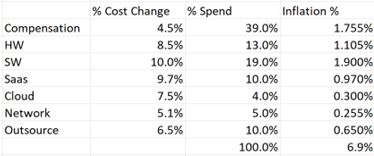
Source: Rubin Worldwide
The Bottom Line
Just as a central bank manages monetary policy for a national economy, an organization needs to manage its technology monetary policy—what to spend, how to invest, and how to generate value.
You can't set monetary policy without understanding inflation. The same is true for technology spending. If you're not tracking IT inflation, you're budgeting blind.
IT inflation—and the spiraling costs of AI—are forcing CIOs to treat technology spending as an economy, not just a budget line. Organizations that master their technology economics will have a significant advantage over those who don't. Here's where to start:
-
Calculate your IT Inflation Index. Use the method above to understand your organization's actual rate of IT inflation.
-
Compare it to your budget increase. Determine the gap between your computed inflation rate and your planned budget increase. What's the impact? What actions need to be taken to address any deficit? Inform your board.
-
Factor IT inflation into board conversations. Make it clear to your board or oversight committee that, just as inflation is considered when setting a nation's monetary policy, processes need to be in place to account for its impact on IT spending.
-
Consider establishing a technology economics function. Whether it's a dedicated technology economist role or a cross-functional capability, someone needs to own the economic discipline around technology investments.